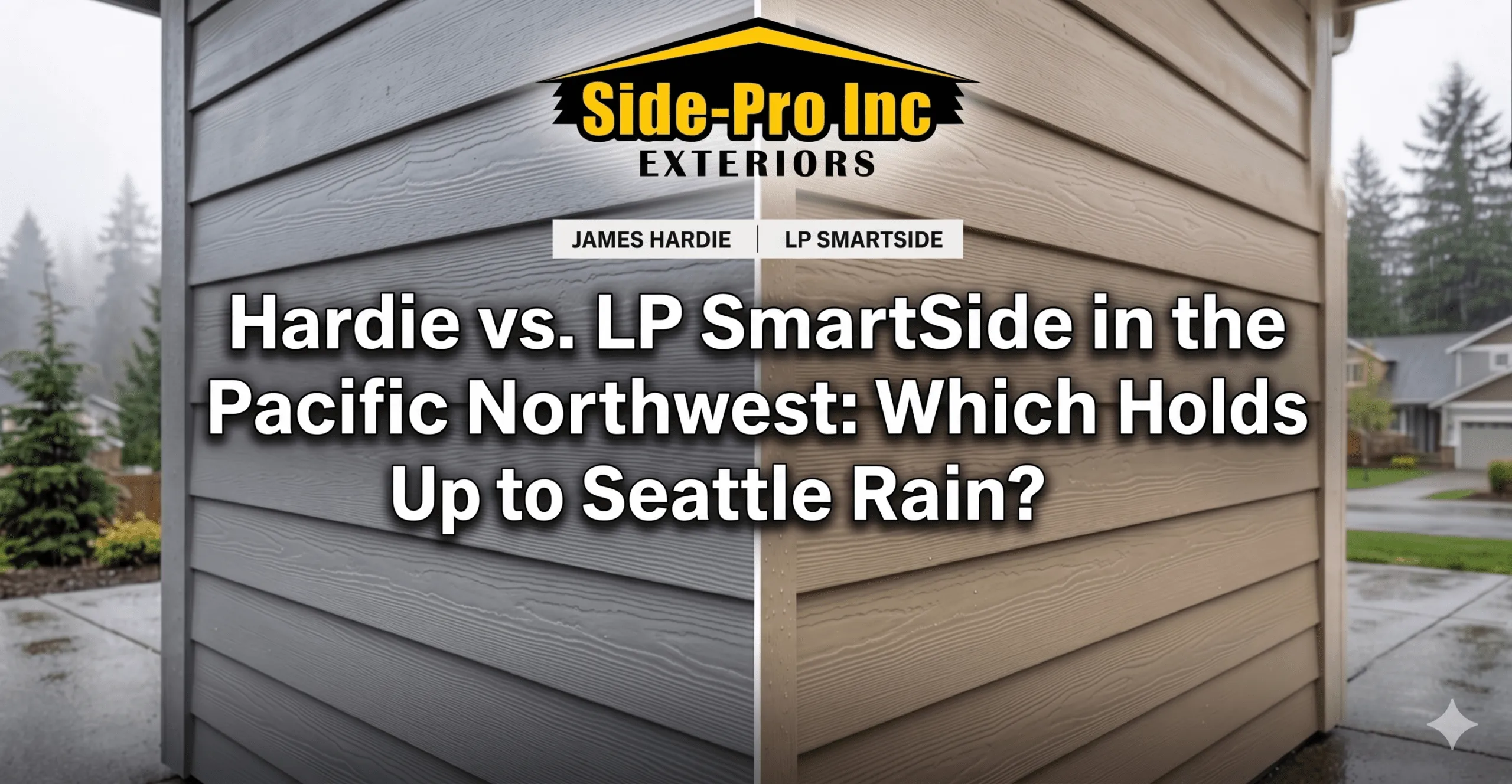
If you’re choosing siding for a home in the Seattle area, you’ll almost always end up comparing two products: James Hardie fiber cement and LP SmartSide engineered wood. Both are mainstream, both are warrantied, and both look great when installed correctly. The right answer depends on your home, your lot, and what failure mode you most want to avoid.
This guide compares the two products on the criteria that actually matter in the Pacific Northwest — moisture, mold, impact, fire, finish life, and repairability — and gives you a framework for deciding.
Pacific Northwest Climate Stress Test
In Western Washington, siding spends 8+ months a year wet. Whatever you choose has to handle constant moisture, freeze-thaw cycles in the foothills, falling branches, and UV on the south face — every single year, for 30+ years.
The criteria that separate good PNW siding from regret:
- Moisture and rot resistance — can it survive constant rain without swelling, splitting, or feeding mold?
- Impact tolerance — wind-driven branches, hail, ladders, weed-whackers.
- Fire performance — increasingly relevant as PNW fire seasons lengthen.
- Finish lifespan — how often will you repaint in our UV + moisture conditions?
- Repairability — when something hits it, can it be patched without re-siding the whole wall?
James Hardie HZ5 Fiber Cement
Hardie HZ5 is the default safe choice for most Pacific Northwest homes — engineered specifically for our wet, freeze-thaw climate.
How it performs here
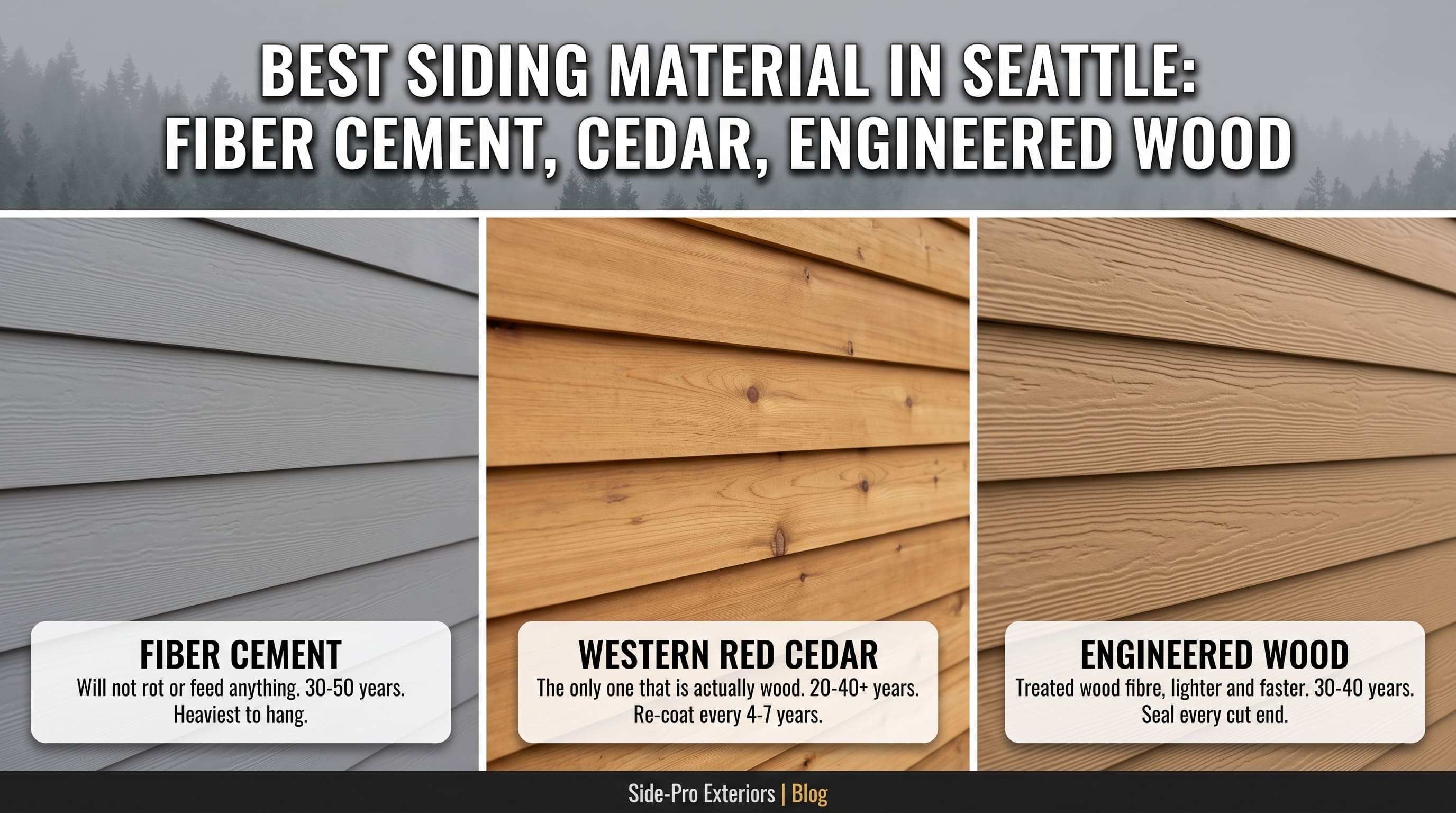
HZ5 is the formulation Hardie ships to Climate Zone 5 (which includes Western Washington). It uses a denser cement matrix with engineered moisture and freeze-thaw resistance. In real-world PNW installs, fiber cement shrugs off rain, won’t rot, won’t feed mold, and carries a Class A fire rating. Hardie’s ColorPlus Technology carries a 15-year limited warranty against fade — the longest finish warranty in the fiber cement category.
Where it falls short
Hardie lap siding is heavy (~2.5 lbs/sq ft, panels are heavier) which means more labor and structural consideration on older homes. It’s brittle on impact — a wind-thrown branch can crack a board. Color matching for repairs gets harder as the original finish ages, and field-cutting requires proper dust control because of crystalline silica.
Best for
Most PNW homes. Especially: homes near trees with consistent moss/moisture pressure, homes in or near WUI fire zones, and homeowners who want to repaint as little as possible.
LP SmartSide Engineered Wood
LP SmartSide is the strongest contender to Hardie when you want a real wood-grain look, lighter weight, or better impact tolerance — but the install has to be right.
How it performs here
SmartSide is engineered wood strands bonded with resin and treated with zinc borate (SmartGuard process) for moisture, fungal, and termite resistance. It’s roughly half the weight of fiber cement (76 Series lap runs ~1.3 lbs/sq ft; the broader product line ranges 1.0–1.7), which makes it forgiving on older framing and faster to install. The deeper wood-grain texture reads more authentic on craftsman, farmhouse, and traditional architecture. Impact tolerance is meaningfully better than fiber cement.
Where it falls short
It’s still wood — combustible, with a Class C flame-spread rating versus Hardie’s Class A non-combustible designation. The 50-year substrate warranty is excellent, but it’s heavily install-dependent: cut edges must be sealed, flashing details have to be perfect, and ground clearance matters. A sloppy install will fail in our climate. Finish lifespan tends to run 10–15 years before repaint in PNW conditions.
Best for
Modern farmhouse and craftsman homes where wood-grain texture is a design feature, retrofit projects on older framing where Hardie’s weight is a concern, homeowners who want maximum impact tolerance, and properties not in fire-risk zones.
Installation Matters More Than the Product
In the Pacific Northwest, the gap between a great install and a sloppy one is wider than the gap between Hardie and SmartSide. Either product fails fast if the install is wrong. Either product lasts 30+ years if it isn’t.
The details that determine whether your siding survives PNW conditions, regardless of which product you choose:
- Proper rainscreen / drainage plane — a continuous water-resistive barrier behind the siding with a drainage gap is essential in our climate.
- Flashing at every penetration — windows, doors, hose bibs, deck ledgers. Cheap or missing flashing is the #1 cause of siding failures we encounter on tear-offs.
- Sealed cut edges — every field cut on either Hardie or SmartSide must be sealed before install to prevent moisture wicking.
- Correct fastener placement and depth — over-driven nails crush the substrate; under-driven nails let panels work loose. Both products have published nailing specs that must be followed.
- Adequate ground clearance — minimum 6 inches above grade, more if you have splash zones or grade changes.
When you’re vetting contractors, ask to see photos of their flashing details — not just finished exteriors. The flashing is where good and bad work part ways.
Side-by-Side at a Glance
| Criterion | James Hardie (HZ5) | LP SmartSide |
|---|---|---|
| Material base | Fiber cement | Engineered wood |
| Weight (per sq ft) | ~2.5 lbs | ~1.3 lbs |
| Moisture / rot resistance | Excellent | Good (install-dependent) |
| Impact tolerance | Lower (brittle) | Higher (dents vs. cracks) |
| Fire rating | Class A (non-combustible) | Combustible |
| Factory finish lifespan in PNW | 10–15 yrs | 10–15 yrs |
| Repairability | Moderate (color-match challenge) | Excellent |
| Best architectural fit | Most styles | Wood-grain aesthetics |
How to Decide for Your Home
The right product depends on three questions worth answering honestly:
What’s the lot like?
Heavy tree cover, persistent shade, falling branches, and constant moss pressure favor Hardie’s dimensional stability and rot resistance. Open lots with sun exposure and minimal impact risk make SmartSide a stronger contender on aesthetics and repairability.
What does the architecture want?
Hardie’s smooth and stucco-textured panels work well for modern, transitional, and traditional homes. SmartSide’s deeper wood-grain texture reads better on modern farmhouse, mountain modern, and certain mid-century styles where the wood look is a design feature rather than a substitute.
How was the home built?
Older homes with marginal framing, retrofit projects with structural constraints, or seismically-vulnerable foundations may benefit from SmartSide’s lower weight. Newer construction or homes where engineering has been verified can take Hardie without issue.
If you’re not sure where your home lands on these questions, a good siding contractor should walk the exterior with you and answer them directly — not push one product as the right answer for every house.
What to Ask Any Contractor Before You Sign
Whichever product you choose, the contractor matters more than the brand. Five questions that separate professional siding contractors from the rest:
“Are you a James Hardie Preferred contractor?” — Hardie’s Preferred program requires installation training and ongoing certification. The Elite tier (which Side-Pro holds) is more selective still.
“Can I see photos of your flashing details and rainscreen installs?” — Anyone can show finished houses. Pros show the layers underneath.
“What’s your written workmanship warranty?” — Manufacturer warranties cover the product. Workmanship warranties cover the install. Insist on both, in writing.
“Will you pull the permit?” — In most PNW jurisdictions, exterior re-side requires a permit. Contractors who skip it are often skipping inspections too.
“Who will be on-site each day?” — Confirm whether crews are direct employees or sub-contracted, and whether the project manager will visit during install.
Frequently Asked Questions
Is LP SmartSide the same as the old hardboard siding that failed in the 1990s?
Does Hardie really need to be the HZ5 product in the Seattle area?
Which product holds paint longer in PNW conditions?
Can the two products be mixed on the same home?
Which product is the better choice if my home is in a fire-risk area?
For more siding questions, see our full siding FAQs.