The Short Version
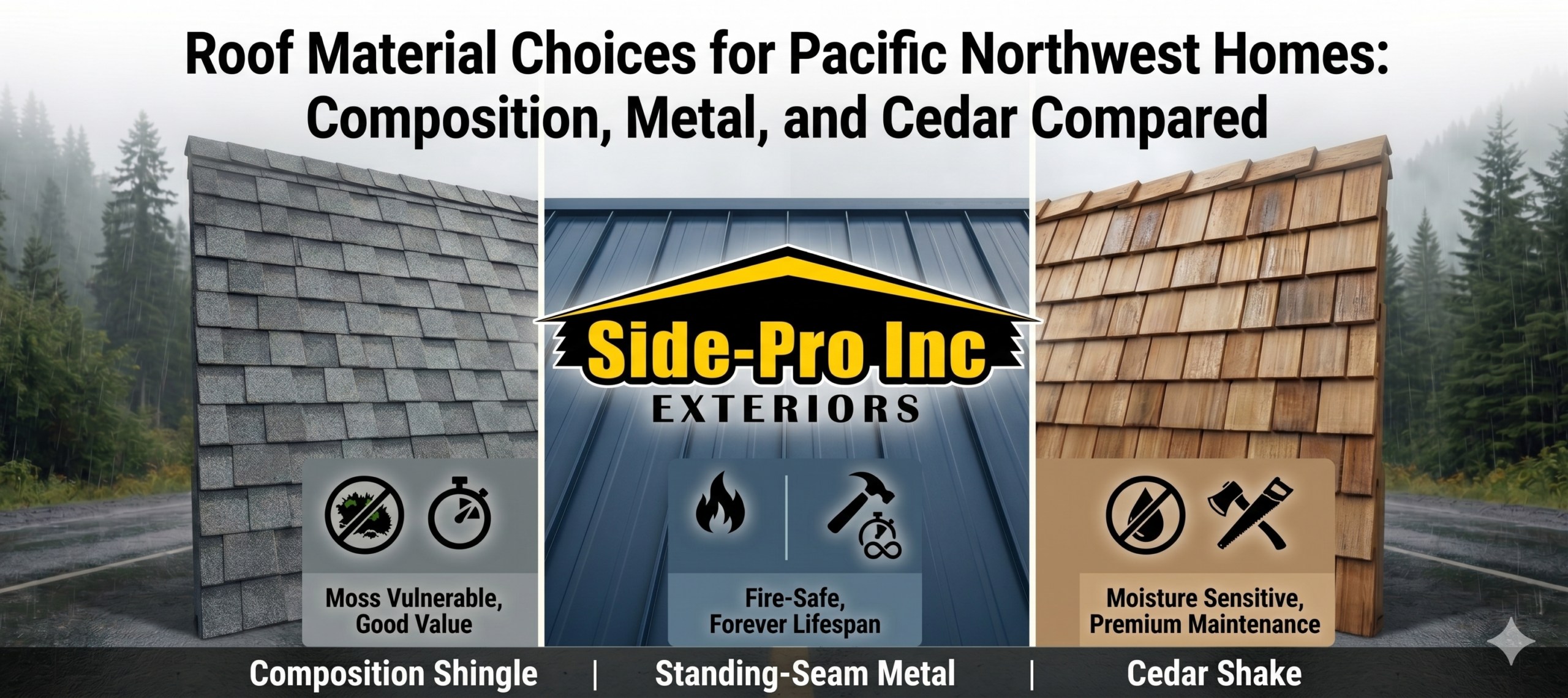
- Composition (asphalt) shingle — most popular, lowest installed cost, 25–40 yr lifespan in PNW. Vulnerable to moss without treatment.
- Standing-seam metal — premium investment, 50+ yr lifespan, sheds moss and snow effortlessly. Highest upfront cost.
- Cedar shake — beautiful traditional look but the riskiest choice in PNW. 20–30 yr lifespan with diligent maintenance, less without.
- Quick decider: Tight budget? → Composition. Forever-home or steep roof? → Metal. Historic home with strict architectural review? → Cedar.
If you’re replacing a roof in the Seattle area, choosing the best roofing material comes down to three mainstream options: composition (asphalt) shingle, standing-seam metal, and cedar shake. Each has a place in the Pacific Northwest, but they fail in very different ways under our 36+ inches of annual rain, freeze-thaw cycles in the foothills, and the constant moss pressure that comes with a damp marine climate.
This guide compares the three on the criteria that actually matter here — lifespan, moss resistance, weight, fire performance, and maintenance — and gives you a framework for deciding.
The Seattle Climate Stress Test
The criteria that separate good PNW roofing from regret:
- Moss and algae resistance — moss eats the granules off composition shingle and lifts the layers; algae stains everything. Material choice plus treatment determines how often you’ll be on the roof.
- Weight — older PNW homes were framed for composition shingle. Heavy materials (concrete tile, slate) often need structural reinforcement.
- Slope tolerance — low-slope roofs (under 4:12) are forgiving for some materials and unsuitable for others.
- Fire performance — increasingly relevant as PNW fire seasons lengthen. Some jurisdictions now restrict cedar shake in WUI zones.
- Wind uplift — Puget Sound storm winds can hit 60+ mph. Fastener pattern and material matter.
- Repairability — when something fails, can it be patched, or do you re-roof a whole slope?
Composition Shingle
Architectural composition (asphalt) shingle is the default safe choice for most PNW homes — affordable, easy to repair, and now widely available in algae-resistant formulations.
How it performs here
Modern architectural shingles (sometimes called dimensional or laminate) routinely deliver 25–40 year lifespans in the PNW when installed correctly with proper underlayment, ice-and-water shield at eaves and valleys, and adequate ventilation. Algae-resistant (“AR”) shingles use copper granules to inhibit the streaking and moss colonization that plague older composition roofs. Limited lifetime warranties from major manufacturers (GAF, CertainTeed, Owens Corning) cover the product; workmanship warranties cover the install.
Where it falls short
Without algae-resistant granules and zinc/copper strips, composition shingle is moss food in our climate. Granule loss accelerates after year 15, especially on north and west exposures. The 30-year warranty is rarely the practical lifespan — figure 25–30 years before re-roof in the PNW versus the 40-year claim on the package. Curb appeal is good but not premium.
Best for
Most PNW homes. Especially: tighter budgets, homes that will be sold within 15 years, and homeowners who prefer manageable cost-to-replace over premium longevity.
Standing-Seam Metal
Standing-seam metal is the long-term investment choice — highest upfront cost, longest lifespan, and the cleanest performance in our wet climate.
How it performs here
Standing-seam panels (24-gauge steel or aluminum, with concealed fasteners and raised seams between panels) routinely run 50+ years in the PNW. The smooth, sloped surface sheds moss before it can colonize, releases snow easily, handles wind uplift well when properly fastened, and carries a Class A fire rating. Modern Kynar-coated finishes hold their color 30+ years with minimal fade. Resale value premium is real and measurable in the PNW market.
Where it falls short
Installed cost runs 2–3x composition shingle. Installation expertise matters more than for any other roof type — bad seam work, wrong fasteners, or incorrect expansion gaps will cause leaks within years. Hail can dent panels (cosmetic, not structural). Walking on it for maintenance requires care to avoid scratching the finish. Repairing a damaged panel mid-roof is more involved than swapping a few shingles.
Best for
Forever-homes, homes with steep roofs where reduced re-roof frequency justifies the cost, modern and modern-farmhouse architecture, homes in or near WUI fire zones, and homeowners who want the lowest lifetime maintenance burden.
Cedar Shake
Cedar shake is the most beautiful traditional roof — and the most demanding choice in the Pacific Northwest. Your maintenance discipline determines its lifespan more than any other material.
How it performs here
Hand-split or taper-sawn cedar shakes give a textured, warm, distinctly Pacific Northwest aesthetic that no synthetic can replicate. Premium #1 grade Western Red Cedar with stainless fasteners can last 25–30 years in the PNW with treatment every 3–5 years (cleaning, fungicide, occasional re-oiling). Cedar breathes, which helps moisture management above well-ventilated attics. The natural look is preferred or required by some HOAs and historic neighborhoods.
Where it falls short
Without religious maintenance, cedar fails fast in our climate — 15–20 years before significant replacement is needed. Moss colonization is severe on shaded north exposures. Cedar is combustible (typically Class C even pressure-treated), and many jurisdictions restrict it in fire-prone areas. Insurance premiums are higher. Annual cost-of-ownership beats every other material once you factor maintenance.
Best for
Historic homes where architectural review requires it, lodge-style and PNW vernacular architecture where cedar is the design feature, homeowners who genuinely want the look and accept the maintenance commitment, and properties not in fire-restricted zones.
Installation Matters More Than the Material
The details that determine whether your roof survives PNW conditions, regardless of which material you choose:
- Ice-and-water shield at eaves, valleys, and penetrations — non-negotiable in the PNW. Many older roofs only have it at eaves; valleys leak first.
- Synthetic underlayment over the full deck — felt paper is obsolete. Synthetic is tear-resistant, waterproof, and more forgiving of timing during install.
- Adequate attic ventilation — ridge vent + soffit intake. Inadequate ventilation causes condensation, premature shingle aging, and ice dams.
- Proper flashing at every transition — chimneys, sidewalls, dormers, skylights. Step flashing done right vs. caulk-and-pray is the difference between 30 years and 8 years.
- Correct fastener spec for your wind zone — Puget Sound homes need more nails and the right pattern.
When you’re vetting roofing contractors, ask to see photos of their flashing details and underlayment work — not just finished roofs. The flashing is where good and bad work part ways.
Side-by-Side at a Glance
| Criterion | Composition | Standing-Seam Metal | Cedar Shake |
|---|---|---|---|
| PNW lifespan | 25–40 yrs | 50+ yrs | 20–30 yrs (with maintenance) |
| Installed cost (relative) | $ (baseline) | $$$ (2–3x) | $$ (1.5–2x) |
| Moss / algae resistance | Moderate (good with AR granules) | Excellent | Poor without treatment |
| Maintenance burden | Low | Very low | High (treatment every 3–5 yrs) |
| Fire rating | Class A (most architectural) | Class A | Class C (combustible) |
| Weight (per sq) | ~250 lbs | ~120 lbs | ~400 lbs |
| Repairability | Excellent | Moderate | Good |
| Resale value impact | Neutral | Positive premium | Mixed (positive on right home) |
How to Choose the Best Roofing Material for Your Seattle Home
The right material depends on three questions worth answering honestly:
How long do you plan to stay?
If you’re selling within 10–15 years, composition shingle’s lower cost is hard to beat — you won’t recoup the metal premium on resale within that window. If this is a forever-home or your kids’ inheritance, metal’s 50-year lifespan and minimal maintenance compound in your favor.
What’s the roof geometry?
Steep, simple roofs (single ridge, few penetrations) are forgiving for any material and metal pays back fastest. Complex roofs (multiple dormers, valleys, hips) drive up metal install cost disproportionately because of the seam and flashing labor. Low-slope sections (under 4:12) often need a different material entirely.
What’s the lot like?
Heavy tree cover, persistent shade, and constant moss pressure punish composition and cedar — both need ongoing treatment. Metal is the lowest-maintenance answer for tree-heavy lots. Open lots with good sun favor any material equally.
If you’re not sure where your home lands on these questions, a good roofing contractor should walk the roof with you and answer them directly — not push one material as the right answer for every house.
What to Ask Any Roofing Contractor Before You Sign
Whichever material you choose, the contractor matters more than the brand. Five questions that separate professional roofing contractors from the rest:
- “Are you a manufacturer-certified installer?” — GAF Master Elite, CertainTeed SELECT ShingleMaster, and similar programs require training and ongoing certification, and unlock extended workmanship warranties.
- “Can I see photos of your flashing and underlayment work?” — Anyone can show finished roofs. Pros show the layers underneath.
- “What’s your written workmanship warranty?” — Manufacturer warranties cover the product. Workmanship warranties cover the install. Insist on both, in writing.
- “Will you pull the permit and handle inspections?” — In most PNW jurisdictions, a re-roof requires a permit and inspection. Contractors who skip it are often skipping critical details too.
- “Who will be on-site each day, and are they direct employees or subs?” — Both can do good work, but you should know which you’re getting and whether the project manager will visit during install.
Frequently Asked Questions
How long does a roof actually last in the Seattle area?
Do I really need algae-resistant (AR) shingles in the PNW?
Will a metal roof make my house louder during rainstorms?
Can I install a new roof over my old one?
How much does moss treatment actually help?
For more roofing questions, see our full roofing FAQs.
Get a Roofing Material Recommendation for Your Home
Side-Pro Inc. has roofed Pacific Northwest homes since 1995. Get a free, no-pressure consultation — we’ll walk your roof, talk through composition, metal, and cedar honestly for your specific home, and give you a real estimate for the option that actually fits.
Mon–Fri 7AM–4PM PT. Serving King, Snohomish, and Pierce counties — Seattle, Bellevue, Tacoma, Everett, Renton.