The Short Version
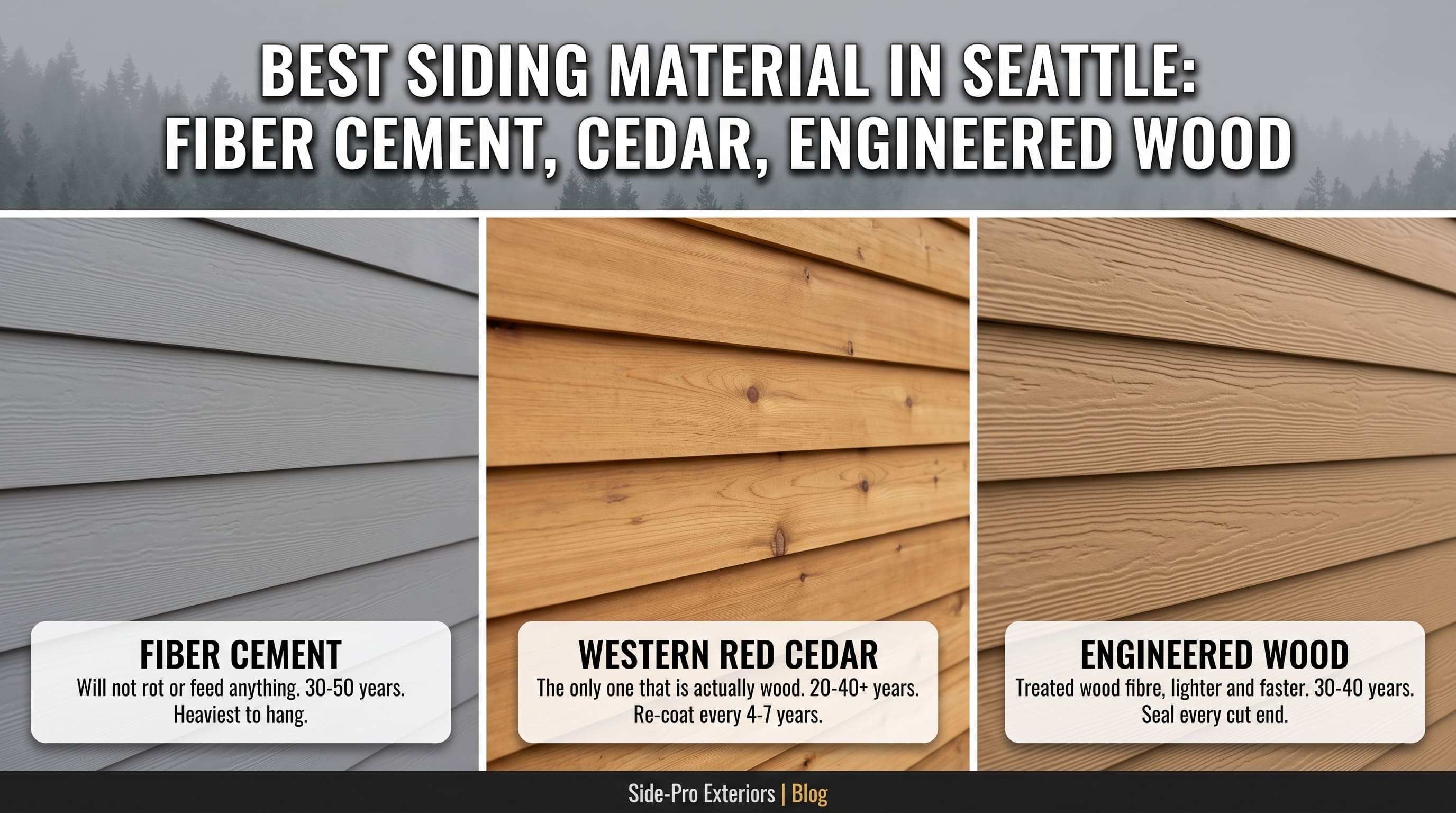
- Fiber cement (James Hardie) — the default for good reason. Cannot rot, holds a factory finish for years, 30-year non-prorated warranty. Roughly $14–$20/sq ft installed. Heavy, and unforgiving of bad flashing.
- Cedar — the only one that is actually wood, and the only one that looks like it. $16–$40/sq ft installed. Expect to re-coat every 4–7 years, sooner on a sunny elevation.
- Engineered wood (LP SmartSide) — real wood fiber, treated so nothing eats it. Lighter and faster to hang, $13–$21/sq ft installed. Best warranty of the three; least tolerant of standing water at cut ends.
- In one sentence — fiber cement is the safe answer, cedar is the aesthetic answer, and engineered wood is the answer when the budget is real and the crew is good.
The Seattle Climate Stress Test
- Eight months of wet. October through May, walls in the Puget Sound lowlands rarely get properly dry. Wood that stays damp for months behaves differently from wood that gets soaked and then bakes.
- Humidity that does not break. Relative humidity stays high even between storms, so a wall that gets wet has nothing pulling the moisture back out.
- North walls that never see sun. On a typical Seattle lot at least one elevation gets no direct sunlight from November to February. That is where moss appears, where paint fails first, and where rot starts.
- A shallow freeze-thaw cycle. Not brutal, but real — overnight freezes December through February, on boards that are already saturated.
Fiber Cement (James Hardie)
James Hardie fiber cement siding — Portland cement, sand and cellulose fiber, pressed and cured into a board. The most-installed cladding on this side of the mountains for two decades, and the reason is boring: it does not care about water.
How it performs here
Fungus cannot eat cement. Neither can carpenter ants or termites. A fiber cement board that gets wet just gets wet — it does not swell, rot or lose structure. On the north wall that never dries, that matters more than any other property.
The factory finish is the other half of the story. ColorPlus Technology is baked on in a controlled plant rather than rolled on in the rain, and it carries a 15-year finish warranty. The board itself carries a 30-year limited warranty that is not prorated — worth the same in year 29 as in year two. Very few exterior products are warranted that way.
It is also non-combustible, which matters in a wildland-urban interface area, and it holds up in wind without oil-canning.
Where it falls short
It is heavy — roughly 2.3 lb per square foot for lap siding. That means more labor, and it means the fasteners and the framing have to be right.
It is also completely unforgiving of bad water management. Fiber cement will not rot, but your sheathing will. Because the board survives, a leak behind it can run for years before anything shows on the outside. When we open up a failed Hardie wall in Seattle, the board is usually fine and the OSB behind it is not. That is a flashing failure rather than a product failure — but the product is what lets it hide.
Cut ends need priming. Butt joints need proper flashing behind them, not caulk. And the warranty excludes damage caused by improper installation.
Best for
Most Seattle homes. Especially any house where nobody wants to think about siding again for twenty years, any north-facing or heavily shaded elevation, and any project where resale matters.
Cedar
Western red cedar siding — naturally rot-resistant because of extractives in the heartwood, dimensionally stable, and — this is the actual reason people choose it — nothing else looks like it.
How it performs here
Cedar is a Pacific Northwest material growing in a Pacific Northwest climate, and it has been on houses here for a century. The heartwood contains natural fungicides. It moves less with humidity than most softwoods, so joints stay tighter. It takes stain beautifully and it can be repaired board by board rather than in sections.
Installed properly — back-primed on all six sides, furred out on a rainscreen so air can move behind it — cedar in the Puget Sound region will run 20 to 40 years and beyond.
Where it falls short
Cedar is the only material here that requires you to do something. Plan on re-staining or re-painting every 4 to 7 years, and closer to every 3 to 5 on an elevation that takes direct sun. Skip two cycles and you are not looking at a cosmetic problem, you are looking at replacement.
The natural rot resistance is in the heartwood. A lot of cedar sold today carries significant sapwood, which has very little of it. Grade matters enormously, and grade is where a cheap cedar bid gets cheap.
Then there is tannin bleed — the extractives that protect the wood will also stain a light-colored finish and streak anything below the siding. And on a shaded north wall, cedar grows moss like everything else here does.
Best for
Craftsman and mid-century homes where the material is part of the architecture. Historic districts. Accent walls and gable ends rather than a whole envelope. Homeowners who genuinely enjoy maintaining a house — and are honest with themselves about that. If you love the look but not the upkeep, the honest middle path is a prefinished cedar-look product.
Engineered Wood (LP SmartSide)
LP SmartSide engineered wood siding — wood strands and fibers bound with resins and treated with waxes and zinc borate, then pressed into boards and panels. It is wood, chemically altered so the things that normally eat wood will not.
How it performs here
The zinc borate treatment is the point: it makes the board unattractive to fungal decay and termites, which is the failure mode that kills untreated wood siding in this climate.
It is meaningfully lighter than fiber cement, it cuts with a standard saw without the silica dust protocol, and it takes a nail without pre-drilling. On a two-story re-side that is real money in labor — which is why engineered wood sometimes lands below fiber cement on a bid even though the board costs more.
The warranty is the most aggressive in the category. LP’s 5/50 covers five years of 100% labor and material replacement, then 50 years prorated on material. Hail up to 1.75 inches is covered when the product is properly installed and maintained. And incorrect installation only voids coverage for damage caused by that specific error rather than voiding the whole warranty.
It also comes in long lengths and wide panels, so there are fewer butt joints on a wall. Fewer joints is fewer places for water to get in.
Where it falls short
It is still wood at the core. Cut ends must be sealed — every one, every time — and the bottom course has to be held clear of grade and hard surfaces. Where fiber cement can sit in a splash zone and shrug, engineered wood will wick.
The prorated half of that 50-year warranty is worth reading carefully. Year 40 coverage is not year-two coverage. And the finish is a coating over a wood substrate — it performs well, but it is not the same proposition as a color baked onto cement.
Best for
Larger homes where the labor savings compound. Homes with a lot of trim and detail. Anyone who wants the deepest woodgrain texture available in a low-maintenance board.
What About Vinyl?
We will be direct: we do not install it, and this is the section where we tell you why rather than pretending it does not exist.
Vinyl is genuinely cheap, genuinely low-maintenance, and it does not rot. In a lot of the country it is a perfectly sensible choice. Here, two things go against it. It hangs loose by design so it can expand and contract, which makes it the least airtight option on a wall that faces horizontal rain. And it reads as a downgrade to Seattle buyers in a way it does not in other markets — which shows up at resale, not on the invoice.
Installation Matters More Than the Material
Siding is a rainscreen, not a raincoat. Water gets behind it — that is expected and normal. What keeps the house dry is the layer underneath.
- The weather-resistive barrier. Properly lapped, and replaced when you re-side — the old one is full of fastener holes from the siding that just came off. We publish every weather barrier and cladding product we install, with each manufacturer’s own figures.
- Flashing at every opening. Windows, doors, and kick-out flashing where a roof meets a wall. This is where the leaks that rot walls actually start.
- A drainage gap. Water that gets in has to be able to get back out.
- Rot repair. Most older Seattle homes need at least some. Budget $2–$4 per square foot on affected areas and carry a 15–20% contingency.
- Who is actually on the wall. Employees or a subcontracted rotation — it shows in the details five years later.
Side-by-Side at a Glance
| Fiber cement | Cedar | Engineered wood | |
|---|---|---|---|
| Installed cost, Seattle | $14–$20 / sq ft | $16–$40 / sq ft | $13–$21 / sq ft |
| Realistic lifespan here | 30–50 yrs | 20–40+ yrs | 30–40 yrs |
| Maintenance | Wash; repaint at finish end-of-life | Re-coat every 4–7 yrs | Wash; repaint eventually |
| Rot / insect risk | None — inorganic | Real; depends on grade and upkeep | Low; treated, but seal cut ends |
| Product warranty | 30 yr, non-prorated | Varies by mill | 5 yr full, then 50 yr prorated |
| Finish warranty | 15 yr (ColorPlus) | None — the coating is yours | Varies |
| Fire | Non-combustible | Combustible | Combustible |
| Weight / labor | Heaviest | Moderate | Lightest |
| Weak point | Hides leaks behind it | Needs re-coating on schedule | Cut ends and splash zones |
Cost figures are installed, wall-area, Seattle-market ranges for 2026. Your bid will land inside or outside them depending on access, stories, trim complexity and what is found behind the old siding.
How to Choose
Choose fiber cement if
You want the lowest-thought option, you have shaded elevations, resale is a factor, or you are in a fire-sensitive area. It is the default because it earns being the default.
Choose cedar if
The house asks for it architecturally, or you actively want a wood exterior and accept the re-coating schedule as part of owning one. If you are not certain you will keep up with it, choose a prefinished cedar-look board instead.
Choose engineered wood if
You want deep woodgrain texture with low maintenance, or you have a big, complicated envelope where labor savings compound. Just confirm your installer seals every cut.
Whichever you choose, spend the argument on what goes behind it rather than on the board. The difference between a 15-year wall and a 40-year wall is almost never the siding. If you are also weighing a roof, we have written the same comparison for that: the best roofing material for Seattle homes.
What to Ask Any Siding Contractor Before You Sign
- What weather-resistive barrier are you installing, and how are the window openings flashed? If the answer is vague, that is your answer.
- Are you installing a rainscreen gap, or is the siding going straight onto the barrier?
- Which James Hardie formulation are you ordering — and can you show me the manufacturer’s zone designation for my ZIP code?
- What happens if you find rot? Get the per-square-foot rate for sheathing replacement in writing before the work starts, not as a change order later.
- Are the installers your employees, or subcontracted?
- Is your labor warranty separate from the manufacturer’s, and how long is it?
- Who pulls the permit?
- Can I see a job you finished five years ago? Not last month. In this climate, five years is the only timescale that proves anything.
Frequently Asked Questions
Which siding lasts longest in Seattle?
Is cedar siding a bad idea in the Pacific Northwest?
Is engineered wood as good as fiber cement?
How much does it cost to re-side a house in Seattle?
Do I need to replace the house wrap when I re-side?
Can I put new siding over old siding?
Get a Siding Material Recommendation for Your Home
There is no material that is right for every house, and a bidder who leads with one before looking at your walls is selling rather than advising. Tell us which elevations get sun and which never do, what the house is now, and how long you plan to stay in it — we will give you a straight comparison, including where we would talk you out of the more expensive option.
Schedule online — free estimates across Seattle, Bellevue, Tacoma and the greater Puget Sound region.