Side-Pro Inc. has been repairing and re-siding Puget Sound homes since 1995. This is how we sort winter siding damage into what needs fixing now and what can safely wait for spring.
The Short Version
- Seattle winters are a rain problem, not a cold problem. November is the wettest month, and the average winter low stays above freezing.
- Fix anything that lets water in now. Open gaps, loose or missing boards, soft wood, failed flashing and water stains inside all get worse every week it rains.
- Cosmetic siding damage can wait. Faded paint, chalky boards and a bit of green on the north wall are spring jobs.
- Painting waits for dry weather. We paint exteriors March through October, not in the winter months.
- Winter is a good time to look. Rain shows you exactly where water goes, and a spring project priced in January is ready to start.
Why Siding Damage Shows Up in a Seattle Winter
Most of the winter siding damage advice online is written for places with snow, ice dams and hard freezes. That’s not us. At Sea-Tac, the average low from December through February sits around 37°F, and a typical year brings only a few inches of snow.
Instead, what we get is water. Seattle sees about 39 inches of rain a year, spread over roughly 156 days. November is the wettest month at about 6.3 inches, and December and January aren’t far behind at close to 5.8 each. (Those are NOAA’s 1991 to 2020 normals.)
So siding damage here rarely starts with one big event. It starts with a small opening, a cracked board or a joint where the caulk let go, and then months of rain find it. A gap that would be harmless in August can let water reach the sheathing every day from November to March.
That’s also why the same few spots fail on house after house: the bottom courses, below windows, around decks, and anywhere a roof line meets a wall.
A 10-Minute Walk-Around for Siding Damage
Pick a dry afternoon, or better, the morning after a heavy rain. Take a flashlight and a screwdriver. Start with the wall that gets the least sun, because that’s where water hangs around longest.
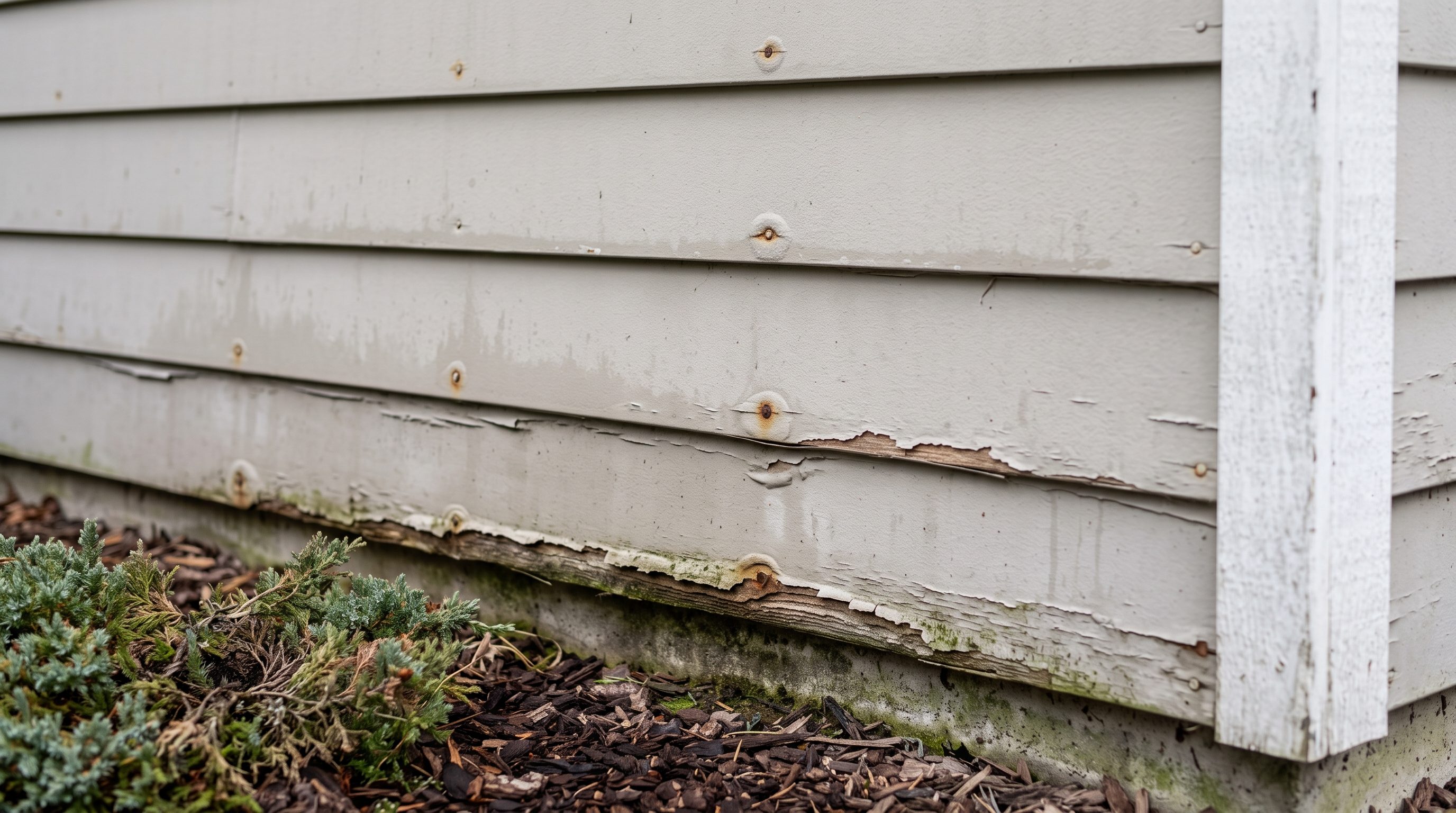
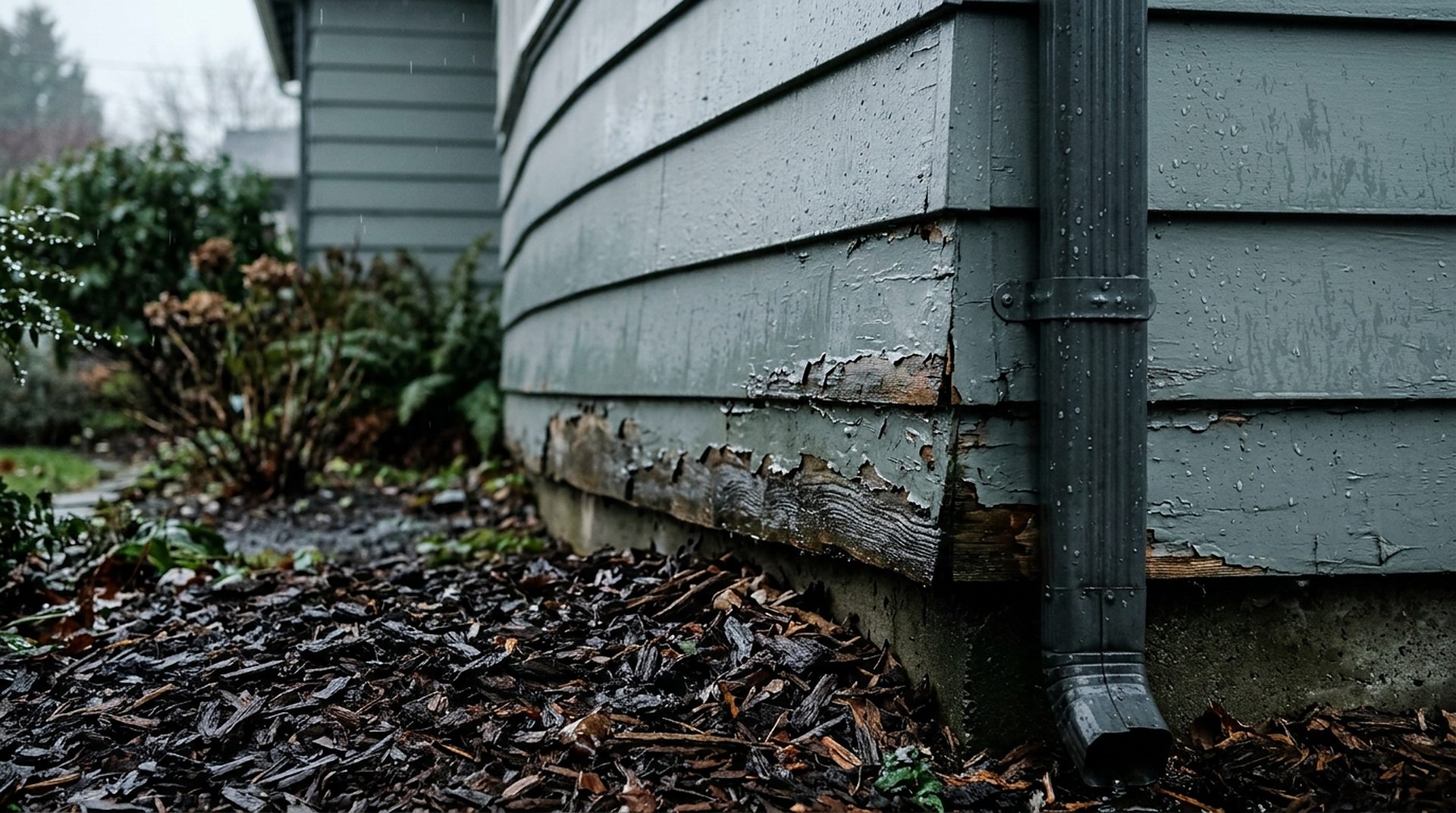
- The bottom two courses. This is where splash-back and wet soil do their damage. Look for swelling, peeling paint and boards that sit in mulch or soil.
- Below every window. Water running off the glass collects here. Dark staining, bubbling paint or a soft sill means the flashing may have failed.
- Where a roof meets a wall. Look for a small angled piece of metal at the bottom of the roof edge, called a kick-out flashing. If it’s missing, roof water runs straight down the siding and into the wall.
- Around decks and porches. The board where the deck attaches to the house is one of the most common rot spots we open up.
- Trim joints and corners. Open caulk joints, gaps you can see light through, or wrap and sheathing showing at the edges.
- Gutters and downspouts. Overflowing gutters dump water down the face of the wall. A downspout that empties against the foundation keeps the bottom of the siding wet all winter.
- Inside, too. Stains on walls or ceilings near exterior walls, peeling interior paint below a window, or a musty smell in one room are often the first sign of water getting behind the siding.
Anything soft is the one to take seriously. Push the screwdriver into the wood gently. Sound siding and trim are hard. If the tip sinks in, you’re past cosmetic.
What Siding Damage Looks Like on Each Material
The checks above work on any house. However, each material also shows siding damage in its own way.
- James Hardie fiber cement. The boards themselves rarely rot, so look at what’s around them: cracked or broken boards from an impact, failed caulk at trim, and boards too close to the ground or a roof. Hardie’s own install instructions call for clearance above soil and above roofs and paved surfaces, and a lot of older installs don’t have it. More on the material on our James Hardie siding page.
- LP SmartSide and other engineered wood. Watch the cut ends and bottom edges. Where the paint has worn through, or where nobody sealed a cut end, the board can swell. Our Hardie vs. LP SmartSide comparison covers how the two handle rain.
- Cedar. Splits, cupped boards, black staining around the nails and finish worn down to gray wood. Cedar handles rain well when it’s finished and kept off the ground. Neglected, the bottom courses go soft. See cedar siding replacement.
- Hardboard. Swollen bottom edges, layers coming apart and a ring of swelling around the nail heads. If your house was built in the 1980s or early 90s, read how to tell if hardboard siding is failing before anything else.
- T1-11 and other plywood panels. The bottom edge is the weak point. Look for layers separating and panels that feel soft near the ground.
Siding Damage to Fix Now, and What Can Wait Until Spring
This is the part nobody else seems to write down, so here it is. The question isn’t how bad it looks. It’s whether water can get in.
| What you found | Our call |
|---|---|
| Missing, loose or broken boards after a windstorm | Now. That’s an open hole in your rain protection, so cover or secure it this week, even if the proper repair comes later. |
| Soft or spongy wood you can push a screwdriver into | Now. Rot doesn’t pause for winter. Get someone to open it up and look before it spreads into the framing. |
| Water stains or peeling paint inside, below a window or near an outside wall | Now. Water is already behind the siding. Finding the source matters more than anything you can see outside. |
| Open gaps at window or door trim, with wrap or wood showing | Now, at least a temporary seal on a dry day. A proper re-flash may wait for a dry stretch. |
| Gutters overflowing onto the siding, or no kick-out flashing at a roof line | Now. Cheap to fix and it stops the wall from getting soaked every storm. |
| Siding touching soil, mulch or bark | Now. Pull the soil or mulch back. It costs nothing and buys you the winter. |
| Faded, chalky or peeling paint on boards that are still hard | Spring. It’s a repaint, and painting needs dry weather. |
| Hairline cracks in caulk with nothing open behind them | Spring. Make a note and keep an eye on it after the big storms. |
| Green algae or mildew on the north side | Spring. It’s on the surface. Clean it gently when it’s dry, and don’t pressure wash, which can drive water behind the siding. |
| Old siding that’s tired but not letting water in | Plan it now, do it in spring. Get it priced over the winter so it’s ready when the weather turns. |
Not Sure Which Column You’re In?
If you’re not sure which row you’re in, treat it as a “Now” and get it looked at. An inspection costs you nothing. A winter of water in a wall costs a lot.
What Can Actually Get Done in Winter
More than people think, as long as everyone’s honest about the weather. In fact, most winter siding damage can at least be made safe until spring.
- Temporary protection. Re-fastening a loose board, covering a hole, fixing a gutter, adding a kick-out or moving a downspout. These buy you the season.
- Siding repairs between dry spells. A siding repair on one wall or one section can usually be timed around the weather. A good crew only opens up what it can close and wrap the same day.
- Finding the source of a leak. Winter is actually the best time for this, because when it’s raining you can see where the water goes.
- Pricing a spring project. Walk the house, measure it and get the scope and price agreed now, so the work can start when the dry weather comes.
Painting is the one that waits
Some exterior paints are rated to go on as cold as 35°F. For example, Sherwin-Williams lists Duration, Resilience and SuperPaint at that number. But temperature is only half of it. According to the Sherwin-Williams application guidance, the surface needs to stay dry and above the dew point for about 48 hours after painting. You should also wait at least a day after heavy rain.
In a Seattle winter, 48 dry hours is a big ask. That’s why we don’t paint exteriors in the winter months. Our painting season runs March through October, and even then the surface moisture matters more than the date.
One exception worth knowing about. James Hardie’s ColorPlus boards come painted from the factory, so a new Hardie install doesn’t depend on a paint day. Hardie rates its ColorPlus touch-up paint for use at 35°F and above, and says crews can install the boards themselves when it’s colder.
What Winter Siding Damage Turns Into When It’s Left
Water that gets behind siding doesn’t stay in one place. First it wets the weather barrier, then the sheathing, then the framing below windows and around decks. Over a few winters, that’s the difference between replacing a few boards and rebuilding part of a wall.
We saw exactly that on the Westboro Condos in Federal Way. Once the old cladding came off, the rot underneath set the scope of the job, and it was rarely just one wall. Cladding straight back over it would have hidden the problem for a few years and fixed nothing.
That’s the real reason to deal with the “Now” rows of that table. It’s not about how the house looks. It’s about what’s happening on the other side of the siding while it rains.
If It’s Time to Re-Side, Plan It Over the Winter
Sometimes the walk-around shows siding damage that’s past repair. If that’s you, winter isn’t wasted time. It’s planning time.
- Get it priced. Most single-family re-sides around here land between $30,000 and $60,000, depending on size, stories, material and what the tear-off finds. Our residential replacement page explains what goes into it.
- Pick the material. If you’re weighing Hardie, cedar and engineered wood, start with the best siding material for Seattle homes.
- Ask about the rot rate up front. Before work starts, ask for the price of any rotted sheathing or framing as a written unit rate.
- Look at the process. Here’s how we run our projects, from the first walk-around to the final clean-up.
Frequently Asked Questions
Can you replace siding in winter in Seattle?
Is winter siding damage covered by the warranty?
Will caulk hold if I put it on in the rain?
Is the black or green stuff on my siding rot?
How do I know if water is getting behind my siding?
Should I wait until spring to get an estimate?
Found Something on Your Walk-Around? We’ll Take a Look Free
We’ve been repairing and replacing siding around Puget Sound since 1995, from Seattle and Bellevue to Kirkland, Everett and Tacoma. We’ll walk the house, tell you what needs doing before spring and what can wait, and put it in writing.
Schedule online. Free estimates across the greater Seattle-Tacoma area.